
From Fragmented Care to Seamless Care
Imagine a patient visiting a doctor in Lucknow, getting a diagnostic test in Delhi, consulting a specialist in Mumbai, and managing medicines from home—all while keeping their health information connected in one place.
This is the promise of connected healthcare.
India’s healthcare system is evolving rapidly. From digital consultations and electronic health records to remote monitoring and health apps, technology is changing how patients and healthcare professionals interact. The next big transformation is not simply about making healthcare digital—it is about making healthcare connected.
The Challenge: Healthcare Is Still Fragmented
For many patients, healthcare can feel like a collection of separate pieces.
A doctor has one prescription.
A diagnostic centre has another report.
A hospital maintains another medical record.
The patient may have medicines, test results and previous prescriptions stored across different places.
This fragmentation can make it difficult to get a complete picture of a patient’s health journey.
Patients may have to repeatedly explain their medical history, search for old reports, carry prescriptions and coordinate appointments with different healthcare providers.
The question is: What if all these pieces could work together?
That is where connected healthcare comes in.
What Is Connected Healthcare?
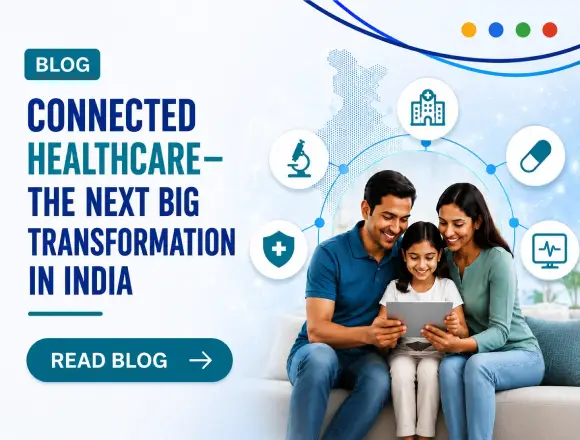
Connected healthcare means creating an ecosystem where patients, doctors, hospitals, diagnostic services, pharmacies, health applications and other healthcare stakeholders can communicate and share relevant information securely.
Instead of healthcare operating as isolated services, connected healthcare creates a continuous journey.
For example:
Consultation → Prescription → Diagnostic Test → Report → Follow-up → Medication → Monitoring
When these steps are connected, healthcare becomes more organised, accessible and patient-focused.
Technology Can Put Patients at the Centre
One of the biggest advantages of connected healthcare is that it can give patients greater control over their health information.
Digital health platforms can help patients manage appointments, prescriptions, medical reports, reminders and consultations from a single digital environment.
For doctors, access to relevant patient information can support better-informed decision-making.
For families, connected healthcare can make it easier to keep track of the healthcare needs of loved ones.
The goal is not to replace doctors with technology.
The goal is to use technology to help doctors and patients connect better.
From Reactive Healthcare to Proactive Healthcare
Traditional healthcare often becomes active when a person becomes unwell.
Connected healthcare can support a more proactive approach.
Regular health tracking, digital reminders, follow-up notifications and remote monitoring can encourage people to pay attention to their health before a problem becomes more serious.
For people managing long-term health needs, continuity can be particularly important. Connected digital tools can help maintain records, follow treatment plans and stay connected with healthcare professionals.
This can transform healthcare from:
“I need care because something is wrong.”
to:
“I am continuously managing my health.”
The Indian Healthcare Opportunity
India has a diverse healthcare landscape. People live across large cities, smaller towns and rural communities, with varying access to healthcare facilities and specialists.
Connected healthcare can help bridge some of these gaps by enabling digital consultations, easier information sharing and remote access to healthcare services.
India’s growing digital infrastructure creates an opportunity to build healthcare systems that are more connected, efficient and patient-friendly.
But technology alone is not enough.
Trust, privacy, data security, digital accessibility and human interaction must remain at the heart of the transformation.
Building a Seamless Healthcare Experience
The future of healthcare should not feel complicated.
A patient should be able to access their health information, connect with the right healthcare professional, manage their medical documents and receive timely reminders without navigating multiple disconnected systems.
This is the vision behind Phir Health—creating a more connected healthcare experience where technology supports a smoother journey between patients and healthcare services.
Connected healthcare is not simply about apps or digital records.
It is about connecting people, information and care.
The Future Is Connected
India’s healthcare transformation is moving beyond digitisation. The next step is integration.
When healthcare systems communicate better, patients can experience greater continuity. Doctors can have better access to relevant information. Families can manage healthcare more efficiently. And healthcare can become more personalised and proactive.
The future of healthcare is not a collection of disconnected services.
It is one connected journey.
And as India moves towards a smarter, more digital healthcare ecosystem, connected healthcare could become one of the biggest transformations in the way we access, manage and experience healthcare.